Showing posts with label Baseball. Show all posts

Monday, June 15, 2020

From Role Player to Manager: Kevin Cash's Amazing Story

Kevin Cash on the Boston Red Sox in 2008
Kevin Cash with the Boston Red Sox in 2008 / Wikimedia Commons

For a player who hit a mere twelve home runs and had a .183 batting average across his nine-year career, you would never expect someone like Kevin Cash to be the key ingredient to a playoff team. As it turns out, he was exactly that, although not as a player, but as a Tampa Bay Rays’ manager in their recent playoff success.

As a player, Cash started as an infielder in the Florida State University program for four years in the late 1990s. After going undrafted after his senior year, he was invited to play in the Cape Cod Baseball League, where he took over as a catcher when the team suffered from injuries. After proving to be successful at his new position, the Toronto Blue Jays franchise signed him as a free agent in 2002.

After two years and over 100 games played for Toronto, the Blue Jays traded him to the Tampa Bay Rays. He spent only a season there until ending up in Boston, where he played for a few seasons. After winning the world series in 2007 with Boston, albeit not as a starting catcher, Cash ended up on the Yankees roster during their historic 2009 season.

Being on a team stacked with superstars like Derek Jeter, Alex Rodriguez, and Mariano Rivera and catcher Jorge Posada, Cash served as a role player for the Yankees. At the start of the season, the Yankees put him in the minor leagues, with the triple-A affiliate in Scranton. The Yankees called Cash to their roster due to injuries among both Jorge Posada and his replacement, Jose Molina. He played ten games on the team, with only six hits to his name before Posada returned to the lineup.

The Yankees released Cash in September, a few months before they would win their 27th World Series. He announced his retirement from the league soon after, only to change his mind and return with the Houston Astros in the 2010 season. After a final stint in Boston and one more season in the minors, Cash retired for good in 2011.

However, Cash remained active as ever in the major leagues from that point forward. In 2012, Cash was hired as a scout for the Toronto Blue Jays. Later on, the Cleveland Indians selected Cash to serve as a bullpen coach for a couple of seasons.

Cash’s most significant contribution to baseball came when he was hired as manager of the Tampa Bay Rays. According to Joe Girardi, this job was fitting for Cash, as he had a positive impact on his teammates and a solid understanding of what makes a baseball team tick.

“(He) really understood the game," Girardi said to the New York Daily News. "Easy to get along with, in a sense, as a player. Easy to work with. He struck me as that type of guy."

Cash played with some of baseball’s all-time greats and was a part of two World Series winners. As a manager, Cash has used his profound knowledge of the game to propel the Rays from a losing team to a playoff contender. Now, Cash is focused on his team’s future and is far from the end of his long career in major league baseball.

Kevin Kobel: Promise and Results

From 1973-1980, Kevin Kobel held tremendous promise as a pitcher for both the Milwaukee Brewers and the New York Mets. He was also the only pitcher for the Brewers to make his MLB debut as a teenager; unfortunately, he never lived up to his promising debut.

Kevin Kobel / 1991 Mets WIZ Card

The Brewers drafted Kobel in the 11th round of the 1971 MLB draft out of Saint Francis High School, New York in the 1971 MLB Draft. After three seasons in their farm system, the Brewers made Kobel a major leaguer at 19.

Eventually Kobel left the Brewers after he got arm troubles in 1975. He returned in 1976, but he did poorly in a few appearances; however, that didn’t end his career. He returned in 1978 to the majors when the New York Mets purchased his contract. He pitched well his first two seasons, becoming a full-time starter in 1979.

Kobel found himself one of few decent players in two particularly dark seasons for the New York team; however, when the 1980 season played out, he fell behind with an ERA of 7.00 and was subsequently removed from the pitching rotation.

One of the main oddities with Kevin Kobel’s career is his downfall with the Mets. Despite playing well in the 1978 and 1979 season and being one of the few good players in an otherwise disastrous season, he still lost his position as a starting pitcher in 1980.

Greg Prince, author of Faith and Fear in Flusing, says the reason can be found in Joe Torre’s search for more reliable players in his quest to improve the Mets’ pitching staff.

“Joe Torre judged others as more reliable starters and Kobel seems to have gotten lost in the bullpen shuffle,” Prince said via e-mail.

This significantly impacted Kevin Kobel’s career as he was no longer regularly used as a pitcher:

“He didn’t get the regular work in 1980 that he got in 1979, especially as a starter, and pitchers tend to thrive on consistent use,” he said.

After this ordeal, Kobel pitched briefly for the Kansas City Royals, Omaha Royals and the Portland Beavers. He retired shortly thereafter.

Wednesday, May 31, 2017

HSMSE boys’ baseball team flourishing without star pitcher

Injuries are an unfortunate, yet common part of athletics. Sports teams constantly presented with injuries are forced to adjust without their key players. The High School for Math, Science, and Engineering boys’ baseball team was not excused from the proverbial injury bug this year. Their top pitcher, junior JJ Katzman, went down with a right arm injury; however, with the pitching of veteran seniors and rising freshman, the team rallied to win its first playoff game in school history.

Katzman’s injury was a result of fatigue and arm discomfort that prohibited him from taking the mound for the majority of the season. Coach David Schieman was forced to place him in centerfield for the rest of the season, as he was unable to pitch.

“My arm isn’t fully strained so I can play most games,” Katzman said. “However, I still cannot throw at full strength. It can be frustrating sometimes, but I’m working through it.”

In addition to his fielding, Katzman was also limited in the batter’s box. Prior to the injury, he had the one of the highest batting averages on the team. Due to the injury, his bat speed became much slower than normal.

“My swing is a bit weaker than usual because I'm not able to use all of my muscles as some tendons are stressed,” Katzman admitted. “But, I'm still able to make solid contact and get on base, so I tend not to worry about it.”

In Katzman’s absence on the mound, the rest of the team’s pitchers have carried the load. Coach Schieman is very impressed at how the team has performed without Katzman pitching. He credits the team for not missing a beat and playing hard throughout every game.

“I think the team has performed very well considering the circumstances,” Schieman said. "The injury to JJ was a tough blow. He’s got a great arm and great understanding of the game. Adam [Greenberg] and Maxwell [Hines] picked up the pitching load along with Tej [Telymonde]. It was great to see us still win games.” 

Coach’s decision to spread out the pitching rotation paid imminent dividends. Four-year veteran Hines has a 1.16 ERA in over 12 innings pitched this season. Greenberg, another four-year veteran, has a perfect 7-0 record with an ERA below 1.00.

The freshman Telymonde has not given up a run in his nine innings on the mound, and his play has given the team optimism about next year. Katzman will also be able to return to the mound next season, as a rising senior. He is focused on getting his arm back to full strength and dedicating his free time to making a full recovery.

“I plan to strengthen my arm's injured area as well as my shoulder and tricep over the summer so I can make up for my current weakness,” Katzman said. “Currently I continue to ice after every game and rest my arm as much as possible when I'm not playing in a game.”

While Katzman will be ready to pitch next spring, he still has high expectations for the team this year. Along with Coach Schieman, he is confident in his teammates’ ability to produce on the field and on the scoreboard.

“Baseball is a team sport so if one man goes down everyone else will fill the void.” Katzman said. “I am extremely satisfied in how the team has played with and without me. It shows how deep we are as a ballclub.”

The team finished with a 10-6 record, four of those wins coming with Katzman on the mound. With the 12th seed, they defeated Ice High School 3-1 at Randall’s Island, with Greenberg pitching another great game. Nevertheless, Katzman is certain that a second round berth is not the ceiling for this team.

“I think this team is capable of winning it all,” Katzman declared. “We just need to be intense from the first pitch to the last pitch of the playoffs, My injury shouldn't be an reason for our great team to lose. We are a championship team, regardless of whether or not I’m pitching.”

Wednesday, June 8, 2016

HSMSE baseball team reaches playoffs for first time in school history

The HSMSE baseball team returned to divisional play in 2016 with authority, recording an 11-5 record and making the playoffs for the first time in school history.

After a winless 2014 season, the Dragons were demoted to the SSAL Developmental League for 2015. The boys had a strong showing with a 5-2 record. Team captain and senior Henry Schoenfeld cited determination to get back to divisional play as a main reason for their success.

“We were motivated to move our way back up [to the A League],” he said.

The team's maturation was a large factor towards their improvement. As the players have become mentally and physically stronger, they have contributed more offensively, helping the team win games.

“We had strong leadership, and we were also older this year,” Scheiman said. “When we did divisional play two years ago, the players who were freshmen and sophomores are now juniors and seniors, and they had better team spirit and a more of a meaning for our team.”

Throughout the year the team got significant contributions from their freshmen, most notably Andre Alexander and Gabriel Culian. Alexander batted .350 as the starting first baseman, while Culian batted .294 while serving as the catcher for most of the season. Scheiman realized the impact the freshmen had on the team.

“They were very meaningful to the team,” he said. “They helped us win games.”
HSMSE Baseball Team / Facebook

The freshmen were helped by the strong leadership of the Dragons, who have eight upperclassmen on the team. With experienced players on the team, it was easier for the freshmen to play well.

“[The upperclassmen] really helped them develop,” he said. "They took them under their wing and showed them they did have a lot of skill and [how] to be confident in themselves.”

Although the Dragons had a great season, they are not satisfied with their accomplishments. The team would like to get back to where they were this year and advance further into the postseason going forward.

“We want to get back to the playoffs,” Scheiman said. “And we want to win a playoff game.”

Friday, May 13, 2016

Dellin Betances living the dream of playing for Yankees

Before Dellin Betances was a star reliever for the New York Yankees, he was a superb pitcher while at Grand Street Campus High School in Brooklyn, just over 11 miles away from Yankee Stadium. Like many New Yorkers, Betances grew up wanting to play for the Yankees; however, Betances was one of the few to realize his dream.
Dellin Betances / Topps

As a high school freshman, Betances was already throwing a fastball in the mid 80s, showing professional potential in just his first year. He was also on his high school’s basketball team, but he stopped playing after an elbow to the mouth knocked out a few of his teeth. After that incident, Betances focused his attention towards baseball.

During his high school career, he was selected to play in the prestigious Aflac All-American High School Baseball Classic in the summer before his senior year. By then, Betances had grown to 6’8" and touched 97 MPH on his fastball, drawing the attention of many major league scouts. He was initially projected to be drafted in the first round, but some teams were worried about his consistency and lack of experience.

As a result of these concerns, Betances fell to the eighth round, where he was selected by the Yankees. Betances struggled with his control for a while in the minor leagues, but made his way to the majors in 2011. Betances was selected to the All-Star game twice in his career, and holds the record for most strikeouts in a single season by a Yankee reliever with 135.

Betances’ career is very young, but he is on the path for greatness. With all of the accomplishments that he earned, none may compare to living the dream of playing for his favorite childhood team.

Friday, June 5, 2015

Lone senior finishing high school baseball career

Geoffrey Nathan - N. Diunte
The High School for Math, Science, and Engineering boys’ baseball team has only one senior graduating this season. Senior second baseman Geoffrey Nathan grew from the only freshmen looking up to everyone, to being a friendly face on a tight-knit team. He concluded his fourth and final year with the Dragons, never having a teammate in his grade.

“I feel honored,” Nathan said. “I do wish I had other people [from my grade], but it’s kinda nice because I can chill with the underclassmen. It’s nice to be the one people can look up to.”

Nathan saw little playing time his freshman year, stepping up to the plate only six times. His role on the team jumped his sophomore year, where he had a .304 batting average in 23 at-bats. Nathan has made consistent contributions for the Dragons ever since.

"We depend more on him for hitting this year than other years," coach David Scheiman said. "He doesn't have to pitch as much."

The team experienced many league changes during Nathan’s tenure on the team. After their 2012 season, the Dragons were moved from the Developmental league to South Bronx B division. This 2015 season was played in the SSAL Developmental league.

“I wish we kept the same [league] the whole time,” Nathan said. “We worked our way up from development league, but then we ended up going back down. At least this year I can help the team get out of developmental.”

A common theme among the HSMSE teams is often the graduating seniors. The baseball team this year will not face this struggle next year; however, Nathan’s contributions and attitude will be missed.

"He's become more comical over the years," Scheiman said. "[He gives] a lot of comedy relief for the team."

Thursday, March 26, 2015

The benefits of unionization for minor league baseball players

Most baseball fans understand that minor league players face difficulties making ends meet, but what they don’t understand is the extent of these obstacles. Most minor leaguers make less than minimum wage during the season, working 60-70 hours per week without overtime. Due to the low pay and long hours, players can’t even afford to live on their own. Many players live with host families who provide a room and a few other necessities for a cheap price.
Salary Stats // Matt Kuperman

“But even as Major League Baseball is booming, raking in more than $8 billion annually, these players are shut out from the profits.”  Ian Gordon said in a 2014 Mother Jones article. “Since 1976, the rock-bottom salary in the majors has gone up more than 2,500 percent; in the minors, it has gone up less than 70 percent. Starting pay for minor leaguers is between $1,100 and $2,150 a month, and only during the season, which can be as short as three months.”

The upside to having a union would be huge for all of the minor league baseball players, allowing them to make more money and have all the hours they work recognized. Taking a look at the A.H.L. (one of the minor leagues for the N.H.L.) that league has been greatly successful because the players make better wages along with housing allowances. Seeing the success of unions in other minor leagues proves that a union would be greatly accepted by minor league baseball players.

“The lifestyle of an AHL hockey player, relatively speaking, it's pretty good,” said A.H.L. hockey player Justin Florek in a 2015 Providence Journal article.

The negative impact for the minor league baseball teams is financial. One solution though would have the teams paying the players higher wages. One proposed idea to fix the problem of low wage was to increase players’ salaries incrementally each year the player is in the league.

“The first step was already stated. Increase the pay period to include spring training and the instructional league.” Robert M. Pimpsner said in a 2015 Pinstriped Prospects article. “Paying players for this extra time will go a long way to help alleviate the burden. Follow it up with a 25% salary increase the next season, a 20% increase the following season after that, a 15% increase after that and finally a 10% increase the fourth year. At the end of this four year period the minimum salary would have risen from the $1,150 to $2,182, combined with increased pay period will mean a first year players could go from $3,450 a year to over $8,000 annually.”

The low pay that minor leaguers endure have motivated Garrett Broshuis, to file a lawsuit against MLB. Broshuis had his own first hand experience of dealing with these problems because he was a pitcher for six years in the Giants farm system. His minor league peers experienced many financial difficulties on account of the small wage and no overtime. Once Broshuis attained his law degree, he sought to improve the conditions for all minor leaguers. Broshuis believes the conditions minor league players are forced into is atrocious and should be addressed by the league.

“One of my roommates was so starving when he came home he would take the ramen noodle and wouldn't take the time to cook them, just would run it under hot water for 30 seconds put the seasoning on it and chomp down. I wasn’t that desperate,” said Broshuis in a 2015 interview with HSMSE/Sports.

Broshuis finds the salary unlawful because the average minor league player works 60 to 70 hours per week, yet only receives between $1,100 - $2,150 per month. This makes housing and other such necessities difficult to attain. Broshuis believes this is a violation of the Fair Labor Standards Act. The nationwide wide minimum wage stands at $7.25, yet according to Broshuis’ calculations minor league players make several dollars per hour less than this. This alleged violation of the Fair Labor Standards Act is the core of his lawsuit.

This article was co-authored by Bruce Mayfield.


Tuesday, May 6, 2014

NCAA walk-on players vs. scholarship players

NCAA walk-on and scholarship players have a rigorous training schedule. They both work virtually all day and are limited in the free time that they have. Even so, there is a major discrepancy in their college careers. Walk-on players have less playing time and don’t always travel with the scholarship players. Walk-on players are players that are skilled enough to make a team without being recruited; however, in order to get the same recognition, walk-on players must work harder every chance they get.

Both walk-on and scholarship players have a very similar routine. They attend classes in the morning, practices, and team meetings. One of the differences is that the players usually don’t play together. Walk-ons in Division I rarely have a chance to travel to away games in sports such as football and basketball.

The NCAA has made minor changes to the rights of walk-on players. As of April 24, 2014, the Division I Board of Directors granted Division I walk-on players unlimited meals and snacks, finally allowing the walk-ons to have access to the same meals as the rest of the team.

“Today we took action to provide meals for student athletes incidental to participation,” Councilor chair Mary Mulvenna said in a 2014 NCAA.org article. “I think the end result is right where it needs to be.”

Although walk-on players have been granted more rights over time, scholarship players are still treated superiorly. Walk-on players having free meals granted to them solves a very small portion of the inequality between them and scholarship players.

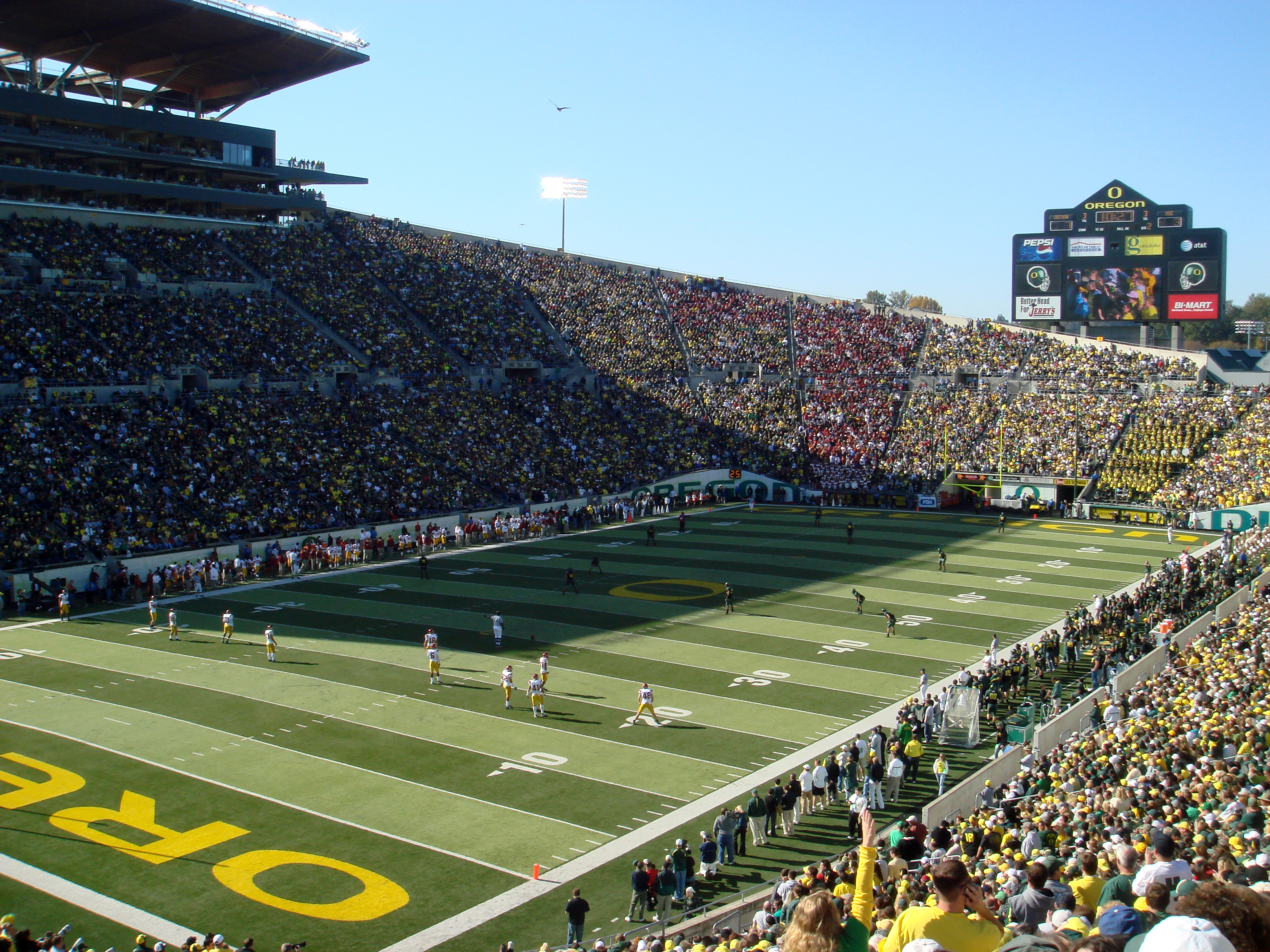
Oregon Ducks Stadium / Bobak Ha'Eri
The biggest difference between the two is that scholarship players are paid to play, whereas walk-on players pay to play.

"You have to consistently stand out on film," Oregon Ducks football player Ryan DePalo explained in a 2013 AddictedToQuack.com article. “They [the coaches] have nothing invested in you, whereas they have $100,000 invested in the scholarship player. If you don't consistently stand out, you will be forgotten.”

The differences between walk-on and scholarship players are undeniable. Walk-ons have fewer rights and fewer opportunity, especially in Division I. Walk-ons have to pay their way through college, only to be overlooked. With scholarship players rallying to unionize, walk-ons are once again being left out to dry.

Written by Asimina Hamakiotes and Gregory Sakas

Wednesday, June 5, 2013

Dragons shutout in first season

Baseball / Wikimedia Commons
Moving up from the PSAL Developmental league to the Bronx South Division, the High School For Math Science and Engineering baseball team faced a rough 0-13 season. Elevating to a higher league did not play in the Dragons favor. This season there were several factors which affected the team’s performance, one being the change in division, which led the team to play twice as many games as last season. After the loss of last year's seniors the team acquired new players who had little to no previous experience in the sport.

This season the team had half the amount of seniors compared to last years roster. The seven seniors that played in the 2012 season had important positions on the field. The team lost most of their starting infield and outfield players. As a result they needed players to step up in order to have the necessary amount of athletes.

“Since we lost a lot of seniors last year, we had to get a lot of people who either haven't played baseball or weren't used to the game so getting to know each other and getting to work together with new players was pretty difficult,” said senior outfielder Kyle Grasing.

The baseball team also struggled this season because the players lacked motivation and the skills required at this level of competition. This was due to the fact that players found the early morning practices very inconvenient. These sessions affected the productivity level of the team and limited the team’s improvement to the few who dedicated their time.

“If someone really wants to play and if someone really wants to work hard, they’ll come no matter what time it is to improve himself,” said coach David Scheiman.

With a higher level of competition, the baseball team had trouble adjusting to the difficulty of the B-Division. They weren’t able to hit against the better pitchers and they weren't able to field the ball well during important situations in the games.

“I think we can definitely improve in our fielding, situational hitting, and in general hitting,” said Scheiman.

The baseball team will need to continue to improve and develop their skills in order to elevate their performance level to meet the demands of their league. They will need to show their commitment and dedication towards the team and attend practices so that they can improve between games. Players should also take the initiative to practice on their own time and go above and beyond league requirements. They have to find a way to navigate through the upcoming season and motivate each other in order to do better next season.

Contributed By Anya Batista and Din Islam 

Monday, April 29, 2013

Jackie Robinson's contribution to the Civil Rights Movement

Jackie Robinson - Wikimedia Commons
The people of the United States voted Barack Obama to office on November 4, 2008, making him the first black president in American history. One can walk down the streets of New York and see people of all colors sharing the same schools, restaurants, and hotels. Although this generation is used to seeing equality in America and the thought of segregation does not cross the average Joe’s mind, it was not always like this.

During the 1940's, everything was segregated from bathrooms and water fountains, to schools and professional sports. Although there is still some discrimination in the United States, there are many laws to prevent segregation and there are organizations such as NAACP that are still trying to advance civil rights. Perhaps the most significant figure in the Civil Rights Movement was Jackie Robinson, who paved the way for future athletes and all people of color to be treated equally.

Signed to the Brooklyn Dodgers in 1947, Robinson had to endure much hate and discrimination in Major League Baseball. Despite his incredible talent, baseball fans did not accept him upon entering the league, and neither did some members of his team. The hotels that the Dodgers would stay at while traveling from city to city did not allow blacks. Robinson would have to find places to stay, which would not always be easy to find even in the same part of town. This is a task Robinson had to get used to in addition to being tired from practice, games, and time on the road. If the restaurants that the Dodgers would eat at did not allow blacks, he would have to either find a different restaurant or wait for his teammates to bring him some take-out after they ate.

His opponents also tried to hurt him on the field, from spiking him harder and more often than other players, to picking fights with him, knowing he was not allowed to fight back. Experiencing all these horrendous conditions, Robinson was still able to take the Dodgers to the World Series in his first year.

His incredible talent showed scouts that whites were not the only ones who can play baseball. The fact that he broke the barrier between whites and colored people in MLB contributed greatly to the Civil Rights Movement, not only in sports, but all angles of life.

Remembering Jackie Robinson

Jackie Robinson - Wikimedia Commons
Jackie Robinson’s battle against racism, segregation, and discrimination for his ten-year baseball career had an impact on America as it is today. Not only was he a role model for the colored athletes to come, but his skills and dedication for baseball made him an extraordinary player.

On October 3rd, 1945 Robinson signed a contract to play for the Brooklyn Dodgers with the help of Brooklyn Dodgers General Manager Branch Rickey. This marked a turning point in American history, as Robinson was the first black person to break the racial barriers in baseball set against people of color. When Robinson was going to sign the contract, Rickey wanted a person that was able to take all the hate and racial slurs that were going to be thrown at him during the games. Robinson fit that persona, and knew that in order to set an example for everyone he had to prove that he had the strength to withstand the discriminatory Americans and ball players at the time.

In the beginning of Robinson’s career, he had to face challenges that the rest of his team didn’t have to worry about.In America at that time his skin color did not let him sleep in the same hotels, or even eat at the same restaurants as his teammates. Robinson had to find ways around these problems for multiple years until people became more tolerant and were willing to let people of color use their services. However, all of this did not happen overnight for Robinson, but the extent to which people were segregated in America declined over the span of many years.

Robinson’s battle against baseball’s color barrier paved the road for many people in America. His skills were not the only thing that made him memorable in baseball, but his patience and self control are what showed people that they deserved their rights. Robinson’s impact on America is still relevant today and his influence played a big role not only in baseball, but permanently changed all sports throughout American society.

Thursday, April 18, 2013

Will the new Angels trio live up to their expectations?

Los Angeles Angels fans are excited for this season with the addition of former Texas Ranger Josh Hamilton. Now the Angels have a trio that consists of All-Star Albert Pujols, AL Rookie of the Year Mike Trout, and Hamilton. Not only are Angels fans anticipating this season, but even the athletes are looking forward to playing together. "I texted him [Josh Hamilton] and congratulated him [on the contract] and he texted back saying, 'Get your legs loose, that's all I ask,''' said Trout.

Mike Trout - Wikimedia Commons
Outfielder Mike Trout has been essential to the Angels since starting with the team in April last year. Trout came out of the minor leagues, but once he started competing in the Major Leagues, he showed what he is capable of and had the statistics to prove it. After only a season he is considered one of the best players in baseball, leading the AL last season with 129 runs and 49 steals. With Hamilton in the Angels lineup, Trout has much more support since Albert Pujols has been mediocre at best these past few seasons.

Albert Pujols - Wikimedia Commons
In the past three seasons, Albert Pujols’ both slugging and on-base percentages decreased. Along with the stats decreasing, his recovery from a knee surgery last October and plantar fasciitis on his left foot will give him trouble on the field. Although Pujols might not be as good as he was a few years ago, Hamilton can easily pick up the slack.
Josh Hamilton - Wikimedia Commons

Mike Trout’s young age leaves room for improvement in his future in the MLB, and Pujols’ 12 years of experience makes him a great leader for the team in the upcoming years. Along with Trout and Pujols, Hamilton’s addition to the lineup makes another threat to opponents when he steps up to the plate. His great performance with the Rangers shows that his addition to the already stellar batting staff will be a big benefit in this season.

Contributed by Sadeon Martin

The Astros move to the American League


At the start of the 2013 season the Houston Astros made their move from the National League Central division to the American League West. The move was a part of an agreement made two years ago when Jim Crane became the new owner of the club.  

Houston Astros logo version for team's caps / Commons
The move was a part of Commissioner Bud Selig’s desire to even out the teams in both leagues. The club was sold to Crane, who many have speculated, that it was set up by Selig. In the event that Crane wanted to buy the team, he would have to agree to move the club to the AL.

There was talk about changing a team from the National League to the American League in 2011, and the Astros were a strong candidate two years before the switch. Their move to the American League was to create a rivalry between the Houston Astros and the Texas Rangers. The shift is a significant change in baseball, "It's a historical day, from opening day on," said Selig to USA Today.

The club moved from one of the arguably weaker divisions to one of the best, which left a question on many fans minds. How will they fare in the AL west? “Easy answer,” said Ken Rosenthal of Fox sports “They won’t.” Rosenthal criticized the club for its lack of direction, stating that the club “[is] caught between trying to rebuild and trying to remain competitive.”

There is doubt of their capabilities in the new position; the Astros will have to prove themselves in their new league and division. But their future in the same position doesn’t look promising as they stand as of April 17, 2013 with a record of four wins and ten loses.

Contributed by: Shawn Watts

Injuries hold the Yankees back from victory

Derek Jeter / By Keith Allison - Flickr.com
The New York Yankees are off to a rocky start this season due to their loss of three superstar players. Derek Jeter, Mark Teixeira, and Curtis Granderson all were injured prior to the start of the 2013 season, leaving only three players from the 2012 starting lineup present on opening day.

Yankees captain Derek Jeter has been at every opening day for the past 16 seasons; however, he was not able to play in the season opener due to a broken ankle he suffered in the American League Championship Series last October. He played during spring training even though he was in pain, which is what he believes led to breaking his ankle once again. "It was something that I hurt it, I continued to play on it, probably when I shouldn't have," he said to BleacherReport.com. "But I continued to play on it and then eventually it broke."

First baseman Mark Teixeira is also not able to play for the first few months of the 2013 season due to a wrist injury. Teixeira is still staying healthy by working with the team's strength and conditioning coach for two-and-a-half hours each day attempting to stabilize his wrist muscles. It is not known when he will return because the recovery time for a wrist injury is unpredictable."You never know when you're coming back from a wrist. You can have a setback. Everything's always a timetable. Timetables change. Sometimes it's shorter, too," Yankees’ manager Joe Girardi said to Newsday.com.

The Yankees’ center fielder and leading home run hitter Curtis Granderson was also injured during spring training when he took a fastball to his right forearm. He is expected to return to play in mid-May; however, the Yankees want to make sure that he is fully recovered before including him in the lineup. “It’s just something that I’ve thought about. I don’t know how many games he would have in his rehab coming back, and that’s a concern for me. So I want him to be comfortable wherever he’s at, because his bat’s real important to us,” said Girardi to MLB.com.

All three of these players made a tremendous contribution to the 2012 season. Both Jeter and Granderson helped their teams offense, while Teixeira impacted the defense. Jeter had an incredible year, finishing with 216 hits, the most in baseball. Granderson also had a great season; he hit 43 home runs, drove in 106 runs, and was chosen to play in the All-Star game. Teixeira was able to contribute to the defense with his elite fielding; he won the Gold Glove Award for his superior individual fielding performance.

They have acquired new players that will need to help the team both defensively and offensively until their three starters return. Lyle Overbay was acquired by the Yankees from the Boston Red Sox during spring training and has been playing first base due to Teixeira’s absence. Eduardo Núñez and Jayson Nix have replaced Derek Jeter and Vernon Wells is a substitute for Granderson. “You’re talking about high-character guys,” Girardi said of the newcomers in a New York Times article. “Guys that have been calming forces in a clubhouse for many years, guys who have played at a high level, guys who have been in the A.L. East, guys that have been in the championship series.”

The Yankees will need to continue working together as a team without these three starters and make plays that will help them win more games. As of now, the Yankees have lost a few games because they do not have the power that Granderson, Teixeira and Jeter normally provide. “The same goals are going to be there: to win every night,” said Youkilis in a New York Times article.

Contributed by Sahar Saedi and Anya Batista 

Thursday, March 21, 2013

The Dominican Republic strides through the World Baseball Classic

Taken by Rabbethan

The Dominican Republic team made their way to the top of the 2013 World Baseball Classic. Focused on winning, they gave it their all in every game. Their victories came from the talent of the team and their pride for the Dominican Republic.

After failing to get to the final in either of the first two editions of the World Baseball Classic, the Dominicans made this one their own. They won the championship by beating Puerto Rico, 3 - 0, becoming the first team to go undefeated in the tournament.

They were able to assemble all of their star players to compete in the tournament and go aggressively at the championship. Their starting lineup features Robinson Cano, Hanley Ramirez, Edwin Encarnacion, Jose Reyes and Carlos Santana and with their combination of speed, power and skills makes them an incredible team.

Going undefeated, the team’s pride is shown by everyone, “The first thing going through my mind, I need to put not just my team but the whole Dominican Republic in front of me,” said Jose Reyes in an interview with The Washington Post.

If the Dominican team treats the Caribbean Series as they did in the World Baseball Classic, this team shows great promise for future victories.

Tuesday, May 15, 2012

What does Hamels mean by saying he was bringing back "old-school" baseball?

Cole Hamels/ SD Dirk/ flickr.com
Philadelphia Phillies left-hander Cole Hamels admitted to purposefully hitting Washington Nationals rookie Bryce Harper in the first inning of the game on May 6, 2012 in Washington. He labeled his actions as, "old-school," baseball. His actions earned him a five day suspension from Major League Baseball.

"I was trying to hit him. I'm not going to deny it. That's something I grew up watching, that's kind of what happened. So I'm just trying to continue the old baseball because I think some people are kind of getting away from it," said Hamels to the Washington Post.

What does Hamels mean by, "old-school baseball"?

He hadn't said a word since his suspension.

This term confused many people that watch baseball. In old-school baseball, pitchers didn't throw at batters to hit them. Instead, they threw high and tight so the batter won't be controlling the plate. Pitchers never wanted batters to be comfortable at the plate.

Not everyone is happy with what Hamels said. Washington Nationals general manager Mike Rizzo was fined by Major League Baseball for his comment about Hamels. "I've never seen a more classless, gutless, chicken [expletive] act in my 30 years in baseball," Rizzo said to Washington Post. "Cole Hamels says he's old school? He's the polar opposite of old school. He's fake tough. He thinks he's going to intimidate us after hitting our 19-year-old rookie who's eight games into the big leagues? He doesn't know who he's dealing with."

Nationals manager, Davey Johnson, who played baseball when it was "old school," was asked about Hamels' comment. "From some things that happened in the past, I don't make a lot of comments on other people's comments," Johnson said to the Washington Times.

Even though Johnson did not want to make a lot of comments about others, he still shared more of his opinions to the Washington Times.

"Hamels making those comments, that's kind of a rare thing to ever happen. That was the most surprising thing. But there have been a lot of things that have changed over the years. That part of the game has changed considerably. I think it's all about prevention of injuries and whatever. And the game used to be policed more in-house. Now we have rules and umpires are trying to control the game more than the players. We used to handle it in-house."

Monday, March 26, 2012

Masanori Murakami, the first Japanese player in MLB

Masanori Murakami autographed photo
Baseball pitcher Masanori Murakami was the first Japanese baseball player to play in the major leagues. He came to the United States to play baseball in the minor leagues, but got promoted to the major leagues after showing excellent play. He started his career in Japan with the Nankai Hawks in 1962. In 1964 and 1965 he played for the San Francisco Giants. After those two years he went home to Japan, where he played baseball for another 17 years.

It was tough for Murakami to play baseball in his childhood. His dad wanted him to become a doctor. He was allowed to play in elementary school, but when he started in middle school his dad wanted him to get serious about a career as a doctor. Murakami had to play in secret. His dad found out about it, but as recalled in Remembering Japanese Baseball by Robert K. Fitts, he reluctantly agreed.

“Playing baseball is okay as long as you continue to study hard.”

As a 17-year-old he signed a contract with the Nankai Hawks. Two years later the major leagues allowed 40 players to come and play baseball in the minor leagues. Murakami was one of those chosen.

“First I thought I’d like to go to college, but then the team’s manager came to the house. He said if I signed a contract, he wanted me to study baseball in America. I promised him I would,” he said in Johnson, Miller, and Wong's San Francisco Giants: Where Have You Gone?

In 1964 Murakami played for the Fresno Grizzlies, the Triple-A affiliate of the San Francisco Giants. The Grizzlies won the Californian League championship, where Murakami had a 1.78 ERA. The management liked Murakami so much that he got promoted to the Giants, where he pitched 15 innings in nine games with a 1.80 ERA.

After Murakami’s first year of playing for the Giants, his contract ran out, and he was supposed to go home to Japan, but the Giants wanted to extend his contract. The Nankai Hawks wanted him back. An agreement was reached; Murakami would play with the Giants for another year and then go back to Japan.

When Murakami came back to Japan he couldn’t play as well as he had done in the United States, because he tried to pitch overhand instead of sidearm which resulted in a sore arm.

“I was even in the hospital in April. When I got out the manager said, 'Throw anyway you like.' I felt he had given up on me but at the same time I felt ‘Yoshi’ – I’ll show them,” he said to Baseball Digest.

He switched back to his old sidearm pitch, with a few adjustments from how he had done in the United States, which improved his play a lot.

“Nankai is surprised by Murakami’s courage and his new spirit. I think he is going to be a real star now,” said a Japanese baseball writer.

After 17 years of playing in Japan he became a commentator for Tokyo’s NHK network. In 2001 he became manager for the Japanese national women’s team. He and his wife now live in Tokyo. He is pleased to see more and more Japanese baseball players in the United States.

“None of them know about me, because they weren’t born yet. For more than 30 years, no one else came. But I am proud to see them now,” Murakami said.
Related Posts Plugin for WordPress, Blogger...