Showing posts with label NCAA. Show all posts

Tuesday, May 12, 2020

Reshaping The NCAA In The Wake Of COVID-19


The Kansas Jayhawk's wrapping up a practice section for the NCAA tournament (Phil Roeder / flickr.com) 

The NCAA made the tough decision to cancel the Men’s Division I basketball tournament on March 12th. This comes as a result of growing concerns about the novel coronavirus. The March Madness cancellation comes as the first since the NCAA started in 1939.


NCAA member schools shut down campuses and sent students home before the cancellation. Schools like Duke University also suspended all athletic events, including their involvement in March Madness amidst growing coronavirus fears. As more major sports leagues suspended their seasons, NCAA President Mark Emmert decided to cancel the Division I basketball tournament, as well as all remaining winter and spring tournaments.


“Today, NCAA President Mark Emmert and the Board of Governors canceled the Division I men’s and women’s 2020 basketball tournaments, as well as all remaining winter and spring NCAA championships,” Emmert said in a statement on the NCAA website.


The league now has to deal with pressing issues. A decision was made on the eligibility of spring sport athletes, with the NCAA approving an extra year of eligibility for all spring sport athletes whose seasons were canceled due to COVID-19. To athletes, this news is bittersweet. Those who agree to return for another year may receive a smaller amount of scholarship money. Coaches from all across the country also begin recruiting in the spring, something now made impossible by the ongoing pandemic.


The NCAA makes about one billion dollars from the tournament annually; however, the decision to cancel March Madness also heavily impacted small businesses, especially sports bars and restaurants. When the event was announced as being closed to the public, there was still hope that people would come in to watch it on TV, but being entirely shut down will cause huge economic damage on these small businesses.


“It’s those local institutions and hourly people, who survive on tips and getting those extra shifts — that’s what will be lost,” sports economic professor Victor Matheson said in an interview with USA Today.


The decision to cancel the March Madness tournaments heavily impacts all aspects of college sports and beyond, even down to local businesses. With the NCAA’s ongoing changes, one can only wonder what will happen for college sports in the coming years.

Thomas O'Shea also contributed to this article.

Wednesday, May 7, 2014

Coaches and administrators opinions on football union

On January 28, 2014 the College Athletics Players Association petitioned that the players on athletic scholarships at Northwestern University are employees of the university. If the claim that the students are employees is supported, the players can unionize. This will allow the players to manipulate the hours they practice reducing the coaches control over the player's schedule.

Northwestern football coach Pat Fitzgerald does not support the unionization of his football players. He believes that this will have a negative result on the realationship the university has developed with the players. He urges his players to vote against the union. He does not see the need for others to intervene with the relationship the players have with the university because the university will provide everything the players need.

“I just do not believe we need a third party between our players and our coaches, staff and administrators. ... Whatever they need, we will get them,” Fitzgerald said in a 2014 Huffington Post article.

Stanford football coach David Shaw also questions the need of a player union in college football.

“I think Northwestern does a phenomenal job providing for their kids, and it's weird to try to unionize but still compliment Northwestern and compliment their coaching staff on being taken care of. Those things don't seem to go hand in hand," Shaw said in a 2014 ESPN article.

The Ohio Valley Conference Commissioner Beth DeBauche participated in a conference discussing the commercialisation of college sports on Tuesday, April 15, 2014. She participated in this conference to give her input on how the NCAA business plan may change to give student athletes what they think they deserve. The student athletes believe they deserve a portion of the large revenue the NCAA receives.

"The landscape as we know it for Division I is going to certainly change in some form or fashion," DeBauche said in a 2014 Associated Press article.

DeBauche admits there must be a change in the format of the business plan in the NCAA. She sees this situation to change the business plan of the NCAA into a positive direction. Many administrative influences on the NCAA like the Big Ten do not see a need for change.

"I have a really hard time envisioning what it would be," Big Ten commissioner Jim Delany said in a 2014 Chicago Business article.

The opinions on unionization of these two coaches and administrators are mostly negative. They believe this idea of a union will conflict with the university’s preparation of the players and it will not fit into the business plan set by the NCAA.

How will college football change if Jeffrey Kessler's antitrust lawsuit succeeds?

Northwestern’s effort to unionize college football players will cause major changes to college football should it succeed. Unionizing will result in the scholarship players becoming employees and will cause financial issues to arise for the NCAA and colleges associated with it.

Many of the changes to college football will stem from the financial issues associated with the new employee status of the players. With the hundreds of football players in the NCAA, there will be a lot of extra money being spent if they become employees; however, it is still unclear how these financial issues will impact college football for the NCAA.

If student-athletes become employees, then the schools will have to pay extra expenses for them. These schools that are going to maintain Division I football teams are going to have to pay 20% in excess of the student’s tuition because of health care, pensions, disability insurance, and unemployment insurance. This is going to lead to a decrease in the amount of money that can be spent to maintain football teams across all divisions in the NCAA.

For the student-athletes, the status change from player to employee will also have its own effects. Colleges can offer its own financial backing plan for each athlete and players can choose which plan is best for them. As a result of that, colleges that have more of a financial backbone can pay for better players than those that do not.

“If you're USC or even Rice, you could say to a recruit, 'I know you're talking to these other two schools, but if you come here we'll pay your medical insurance for five years, plus you can collectively bargain for other things you want, plus if you graduate early you'll get extra dough in a trust fund, and perhaps you can capitalize off marketing value if you become our star quarterback,'” SMU athletic director, Rick Hart, said in a 2014 CbsSports.com article.

Taxes are also another problem that has to be considered. An athlete receives a scholarship to play for a team and study at school as a student. If they are going be employees of the school, the scholarship and wages that they will receive is taxable by the IRS. It would make it increasingly difficult for college football players to pay for and attend college because of the taxes they will be responsible for on both accounts.

"The fact that the players were not considered employees in the past is essentially the reason why their scholarship or parts of it weren't taxed before,” Garret Higgins, a partner of the Exempt Organization Tax and Advisory Services group, said in an ESPN article. ”The IRS may be able to make the argument that the scholarship is really payment for services, and therefore compensation, and is now taxable to the athlete.” 

Financial issues are only part of the reason as to why the changes are coming to college football in the NCAA, but its impact is going to be felt immediately. Smaller universities may not be able to pay as much as larger ones, widening the skill difference across Division 1 athletics. Some student-athletes may find it harder to attend college because of the taxes they are required to pay.  If this lawsuit passes, the NCAA will find their profits cut by a large margin if they want to continue college athletics.

Written by Allan Lee and Sean Santiago

The activities of students versus studnet-athletes

NCAA Logo/ Wikimedia Commons
High school students look forward to college because of all the freedom and choices they get to make, yet collegiate student-athletes do not have this perk. Their commitment to the sport takes up most of their time. They have less freedom than regular students in what they do, eat and study.

College student-athletes have more benefits than regular students regarding scholarships. There are more than 150,000 student-athletes who receive $ 2.7 billion dollars in scholarships every year from NCAA member colleges. They don’t have the burden that regular students face which is to get a job and eventually pay off the debts they accumulated in college.

“The average college student graduates with $35,200 in debt. Athletic scholarships offset these cost for student athletes,” the NCAA said on their website.

The amount of free time that an average student has compared to an athlete is very drastic. A regular student can sleep in and have their first class close to 11:00 AM. They have much more opportunities and can pick almost all of their classes. They choose, when they eat, sleep and go to bed.

The average student-athlete will have to follow a much more strict and exact schedule. An athlete's life will be controlled by the demands of their coach. On an average day, they can have practice starting as early at 6:00 AM. Their whole schedule revolves around games, travel times and practice.

When college students go out at night, they may consume alcohol or drugs. Even though it’s illegal to do recreational drugs and drink if you are underage, they do it anyway. If you are a college athlete, it is a different story.

“The NCAA shares the responsibility of promoting a drug-free athletics environment with its member institutions to protect the health of student-athletes and preserve fair competition,” the NCAA said on their website.

If a student-athlete is found consuming illegal contraband, then their consequence will be very severe, and they could possibly lose their scholarship.

“Testing positive on an NCAA mandated [performance enhancing or recreational] drug test will result in a loss of 25 percent of an athlete’s total eligibility from the day the athlete tests positive, which is one whole year for most.” said Monica Worsley in a 2012 Times-Delphic article.

The meal plan of student costs a lot of money. The plan combined with the cost of housing take up a majority of their expenses. Some colleges are starting to give their athletes free meals.

“This week, the NCAA ... approved a rule to allow schools to provide all Division I student-athletes with unlimited meals and snacks,” said Stefanie Loh in a 2014 U-T San Diego Article. “Previously, schools were allowed to give athletes one snack and one training table meal per day."

Students who have have scholarships may have the cost of college reduced, but they miss out on the liberties that college has to offer. Students who are non-athletes make their own schedule, but they don't get the prestige of playing on a team.  With such a strict schedule to follow, how do student-athletes have any time to relax?

 By Willy Herman and Daniella Smith

Professors voice opinions of NCAA athletes receiving pay

The argument whether or not NCAA student-athletes should receive pay has been in discussion almost since the beginning of college sports. In recent issues involving student-athlete pay, college professors have wanted an input on this issue. A sample group of professors were selected by U.S News to voice their decision on the subject of paying student-athletes. The majority of this selected group have been more supportive than opposing on the union being paid, and viewers of these opinions were allowed ratings of the responses and more of the supporting articles received positive feedback. 

Professors that feel student athletes should receive no pay at all, say it would be far too expensive to fund all NCAA athletes. Professors argue that if NCAA athletes saw that the football team was unionizing and receiving pay, then they would too push to have more privileges that the NCAA would not be able to afford. 

“The Division I colleges could afford this expense when the median DI athletics program loses $11 million a year on an operating basis and much more when capital and indirect costs are included,” said by Andrew Zimbalist in his response article The Cost of Paying Athletes Would Be Far Too High

Other professors argue that because the NCAA is a big business, the athletes should be paid part of the profit because they are the reason the money is coming in. 

“Without them—on the field or on the court, performing and entertaining millions of college sports fans—the billions of dollars that collegiate athletics generates simply would not exist.” said Bobby Rush in his response article towards The Cost of Playing Athletes Would Be Far Too High

Rush, a democratic representative for the state of Illinois, continued to say how the merchandise that is sold on campus and a games are because of the players and who are entertaining the large audience. Without them receiving pay for their work, there is no purpose to work at all. 

From the selected group of college administrators that voiced their opinion, the group that were against unionizing were mainly college professors whereas the members that were in favor of unification were board members and work in the sports administration. This may show a biased selection group of younger administrators or those who are more close to the athletes which would probably give biased opinions against them receiving pay from the professors. 

Not until recently however, have professors openly shared their opinions on this issue. Whether or not the athletes will receive pay and be acknowledged as a union will only be determined by the legal system.

Tuesday, May 6, 2014

What if college athletes get paid?

Northwestern University/Michael Barera-Wikimedia.commons
The death of the National Collegiate Athletic Association elite student-athlete is fast approaching. The unionization movement by the football players at Northwestern University could lead to athletes receiving a salary. If student-athletes are paid, the whole economic system of the NCAA will change.

If the football players get a salary and added benefits, there will be cutbacks in the resources in colleges that are not on the top of the NCAA. Title IX will play a role in this because all students will need to receive equal benefits from the unionization.

“How will schools pay for pay and benefits to scholarship student-athletes, Title IX considerations, workers’ compensation insurance and increased taxes due to loss of tax-exempt status,” Glenn Wong, a professor at the University of Massachusetts, said in a 2014 NYTimes.com article. “For 23 schools in Division I, it will be easy.”

All other Division I schools will have trouble financing pay for their athletes. These schools will have to reduce the coaches’ and administrators’ salaries, and remove programs for other students just to pay the players.

The NCAA spends less than ten percent of its resources on both Division II and III colleges, but this will fall lower if student-athletes get paid. Even if Division II or III athletes don’t get paid, budgets could still be decreased. If Division I athletes receive a salary, then more of the NCAA’s resources must be spent to compensate for everyone’s salary.

“If that changed, our budgets would change,” Kris Diaz, the athletic director at Division III Baldwin Wallace, said in a 2014 dispatch.com article.

The best of the best athletes will receive higher salaries and more benefits, including better medical care for injuries and compensation. These added perks will only go to scholarship players not the walk-on players.

“There is no question but that the presence of a union would add tension in terms of creating an ‘us' versus ‘them' feeling between the players it would represent and those it would not," Fox News quoted Northwestern’s 21 page document in a 2014 article.

Contributed by: Nicholas Bohan and Velid Mulic

Off-season training for college athletes: a blessing or a curse?

Off-season training at Simon Fraser University / SFU Public
Affairs and Media Relations - flickr.com
An NCAA student-athlete needs time to rest and recover between seasons, as well as gain strength and endurance for the upcoming year. This is the function off-season training serves. It is a period for athletes to stay in shape and put in effort towards success and improvement in their abilities, both physically and mentally.

Although the off-season is an advantageous time for most athletes, it comes with serious drawbacks. The off-season training puts athletes at risk of injuries, both catastrophic and non-catastrophic, and there have even been reported deaths between seasons for several NCAA sports.

Off-season workouts differ among sports, but they all have one thing in common: important progress is made towards improving student-athletes’ physical condition and sport-specific skills.

“Summer participation allows a wrestler the chance to greatly accelerate the training program without the normal pressures and hassles of the winter folkstyle environment,” Southern Maryland Wrestling Club Head Coach Dr. Bruce Gabrielson said in a 1992 article on SMWC.org.

Besides increasing strength and stamina, off-season training also serves as a time to reinforce a sense of teamwork, as well as to set individual goals for oneself and learn to adapt to changes.

“The off-seasons helps you build as a team through all the time spent together and brings you closer together so that you can trust each other on the field,” William Jewell College junior football player DJ Balazs said in a 2012 article on TheHilltopMonitor.com. “Team chemistry is vital in order to perform as best as possible.”

Despite the benefits, off-season training has some serious dangers. Student-athletes increase their risk of injury, usually when they overwork themselves in an attempt to get ready for the upcoming season. The NCAA Injury Surveillance Program (ISP) has implemented multiple methods to document and limit these injuries; however, they cannot manage to record each and every one. In fact, the NCAA ISP does not include off-season injuries in their annual reports.

The NCAA Datalys Center for Sports Injury Research and Prevention wrote a 2013 article about the historical difficulties in the surveillance of injuries during the off-season.

“Student-athletes are at risk of catastrophic injury during off-season training. However, little remains known about the risk of non-catastrophic injury during the off-season.”

An even bigger threat is the risk of death. The off-season is known as the "Kill Season" in the NCAA, as 19 deaths have occurred since 2000. It is important to note that these deaths were non-traumatic, which means there was no impact or injury during a game. They happened merely during workout routines. Many student-athletes even claim that their strength and conditioning coaches went beyond the allowed eight hours a week of workout time, exerting their players more than is legal or, for that matter, safe.

“The way we're training college football players in this day and age is putting them at risk," president of the College Athletics Trainers Society Scott Anderson said in a 2011 article on CBSSports.com.

The off-season can be a beneficial time for student-athletes to improve their skills and prepare for the next season, if they focus their energy effectively and do not overwork themselves. Injuries, and even deaths, are a serious and real problem, and the NCAA has not done enough to limit or prevent these from happening.

NCAA walk-on players vs. scholarship players

NCAA walk-on and scholarship players have a rigorous training schedule. They both work virtually all day and are limited in the free time that they have. Even so, there is a major discrepancy in their college careers. Walk-on players have less playing time and don’t always travel with the scholarship players. Walk-on players are players that are skilled enough to make a team without being recruited; however, in order to get the same recognition, walk-on players must work harder every chance they get.

Both walk-on and scholarship players have a very similar routine. They attend classes in the morning, practices, and team meetings. One of the differences is that the players usually don’t play together. Walk-ons in Division I rarely have a chance to travel to away games in sports such as football and basketball.

The NCAA has made minor changes to the rights of walk-on players. As of April 24, 2014, the Division I Board of Directors granted Division I walk-on players unlimited meals and snacks, finally allowing the walk-ons to have access to the same meals as the rest of the team.

“Today we took action to provide meals for student athletes incidental to participation,” Councilor chair Mary Mulvenna said in a 2014 NCAA.org article. “I think the end result is right where it needs to be.”

Although walk-on players have been granted more rights over time, scholarship players are still treated superiorly. Walk-on players having free meals granted to them solves a very small portion of the inequality between them and scholarship players.

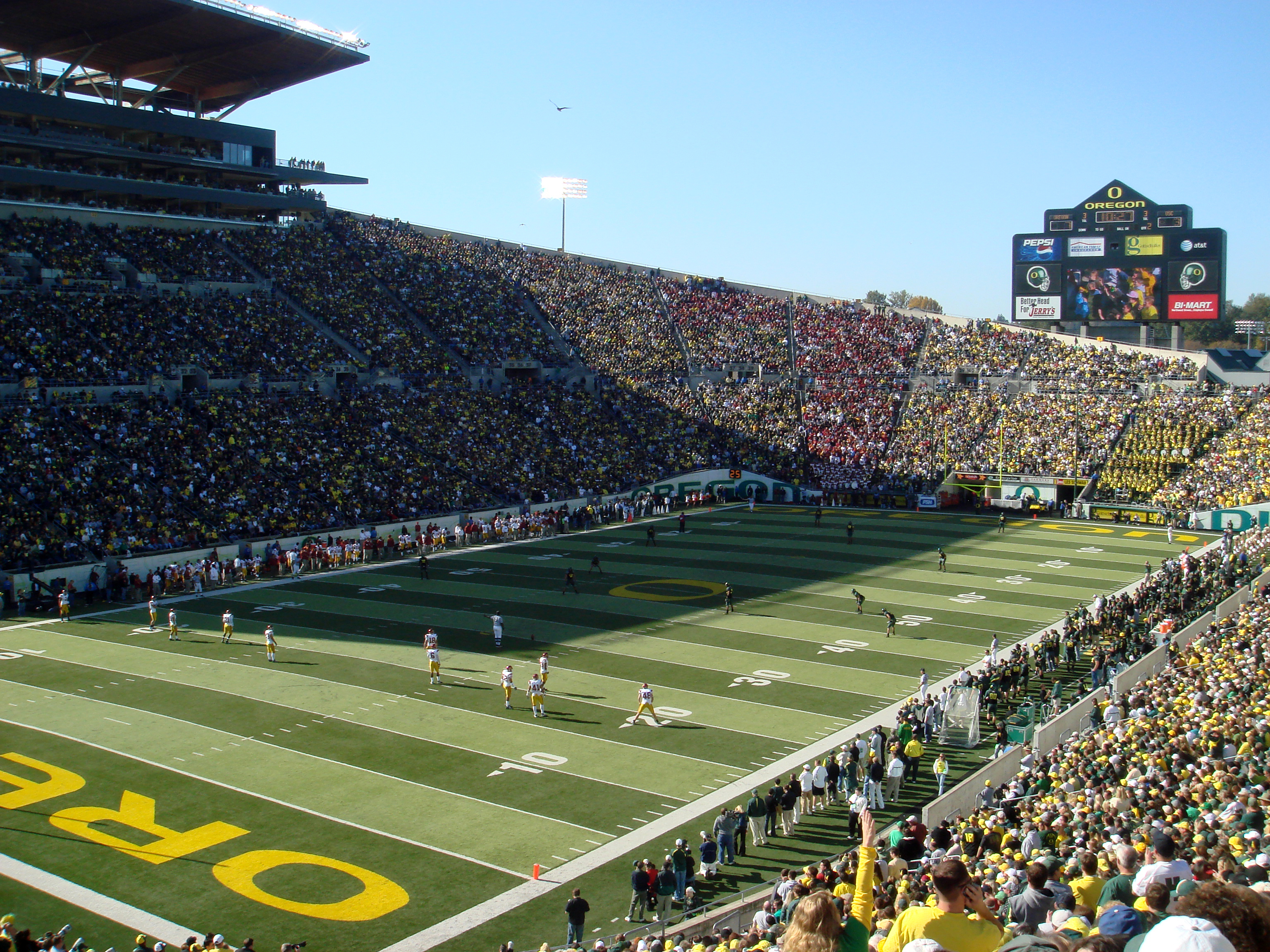
Oregon Ducks Stadium / Bobak Ha'Eri
The biggest difference between the two is that scholarship players are paid to play, whereas walk-on players pay to play.

"You have to consistently stand out on film," Oregon Ducks football player Ryan DePalo explained in a 2013 AddictedToQuack.com article. “They [the coaches] have nothing invested in you, whereas they have $100,000 invested in the scholarship player. If you don't consistently stand out, you will be forgotten.”

The differences between walk-on and scholarship players are undeniable. Walk-ons have fewer rights and fewer opportunity, especially in Division I. Walk-ons have to pay their way through college, only to be overlooked. With scholarship players rallying to unionize, walk-ons are once again being left out to dry.

Written by Asimina Hamakiotes and Gregory Sakas

Aftermath of employee status

Student-athletes have little to no voice regarding their liberties in the National Collegiate Athletic Association (NCAA). Student-athletes have very strict hours of practice and game-related activities, and are unable to dictate what they do during this time. With the brewing Northwestern unionization case, many questions surround the future for student-athletes if they obtain the status of an employee. The Northwestern players are currently fighting for a union that would allow them to become employees in the eyes of the NCAA and have security from the strict collegiate rules.

The NCAA is liable for multiple important changes if the athletes win this case. As an employee, the players would be entitled to a salary. If players were given salaries, many schools would be losing money since only 10 percent of college sports generate revenue. The NCAA would be required to pay every player at least minimum wage regardless of the sport. Most NCAA sports barely bring in enough money to sustain themselves, sending them into further debt and possibly leading colleges to dropping sports. Although the colleges are losing a lot of money, the players are getting help since they are unable to get jobs with all the sport and educational responsibilities they have.

"All of us have bills. All of us have expenses, just like every other student,” Alabama long snapper Carson Tinker said in a 2013 Huffington Post article. “I don't live with football players. I live with two of my good friends. While I'm at practice every day, they have a job. They're able to pay their bills, buy food, stuff like that."

The major issue behind being a student-athlete is, they do not get reimbursement when they are significantly hurt. 

“Injuries sustained in college athletics that linger or develop into chronic conditions are generally not covered by a university’s or the N.C.A.A.’s medical insurance once an athlete has left college,” Bill Pennington said in a 2013 New York Times article.

Currently, student-athletes who are on scholarship are all at risk of losing their assistance after they are seriously injured.

“There is also no provision in the Division I Manual to prohibit a coach from revoking a scholarship the year after a recruit gets hurt.” Meghan Walsh said in their 2013 Atlantic article.

Players becoming employees would hurt not only many colleges, but also put the NCAA in jeopardy of collegiate sports. The players would have significant more freedoms and the NCAA would have to change their current no wage approach.

Written by Sadeon Martin and Justin Wu

Monday, June 4, 2012

Should college football be banned?

Many people in the United States love to watch college football in their free time. The thrill of the marching bands, cheerleaders, and best of all the brute force of the dedicated athletes are factors in why the fans love the sport. College football has been around for more than 100 years and since the late 1900's the players have grown stronger and faster. The intensity of the game has increased and the safety of the players is a concern we can't ignore.

A big reason to ban college football is because of the constant blows to the head. Examples of players that go through the repetitive brutal hits are linemen and running backs. The short term affects of these rapid hits are concussion, memory loss and Chronic Traumatic Encephalopathy, or CTE, but the long term affects are still unknown. The long term damages can be severe and there is no way to find out until after the player's death. CTE is so severe that Malcolm Gladwell said in an Intelligence Squared debate at New York University, “I’ve seen pictures of the brain scans of people with CTE and it looks like someone drove a truck across their brain.”

While the student-athletes are at risk of getting injured every day during practice, their education is being ignored. Football requires dedication so the students are spending the majority of their time at practice or at the gym for improvement. The student-athletes' education was primarily their main focus going into college, but once they engage in the sport they sacrifice the time they could have used learning for a football scholarship.

College football is an exciting sport, but changes are a necessity. The games are more intense than ever and players are violently tackling each other. Safety of the players is a problem and banning it is a solution. There are other alternatives such as giving the student-athletes a reasonable salary or better schedules to reduce play time, but the sport will still be unsafe for the young athletes.

Ban college football

Whether or not college football should be banned is a very controversial topic. Although college football does provide universities with great revenue and allows many companies to advertise, it destroys the players. Everyone knows that football is one of the most brutal and harmful sports. In an eight year period, study by sagepub.com, it was discovered that a total of 175 head and neck injuries were found in 100 players not to mention all the abnormalities found amongst freshmen on the team. These football players should dedicate the time they spend playing to studying and maybe enjoy the sport during their free-time.

The reason colleges encourage students to play sports is because it generates a huge amount of profit. Not only do universities receive money from the sale of tickets, but they also get it from advertisements and merchandise. Companies, such as Dish Network, Ford, Coca-Cola, etc, pay thousands of dollars to colleges as endorsements. The University of Tennessee’s football team receives 750,000 dollars from corporate sponsors. Most of the top universities pay their coaches about one million dollars, but the people who are performing out there cannot get paid?

Football is renowned for having injuries to the head. Many football players suffer from Chronic Traumatic Encephalopathy, also known as CTE, which is a degenerative disease of the brain. It causes the person who is suffering to lose memory, concentration, and attention. CTE is a result of many traumas to the head. Furthermore, hints of brain damage or injuries to the head can only be found our after death.

In football, players receive beatings to the head and even with helmets they get concussions. Mike Borich, former college wide receiver and later football coach for the Chicago Bears, died of a drug overdose at the age of 42. After his death an autopsy was performed and it was found that he suffered from CTE. Borich was the first college wide receiver to ever be diagnosed with CTE.

With college football there is a slight chance that the player might get into the NFL, but that is going to require sacrifices. They may not receive a good education, therefore if they do not get drafted, there is no other option. Furthermore, with college football there is a huge probability that the player may get a head injury. Knowing that the head is one of the most crucial parts to a person, a blow to it may cause problems throughout the body. Now the only thing that is left to do is ban college football.

Consequences of college football

All around the United States, people are debating whether or not to ban college football. The purpose of college is to study and to major in fields that interests people as collegians. If one isn't interested in any of the fields, then why go to college? Football takes academics out of students' obligation of trying and studying hard since most football players are guaranteed a scholarship. Not only that, but how can one obtain benefits from playing college football? The chances of one football player ending up making money later on in life from football are very low. Also, the fact that football is a contact sport makes it dangerous. Hits in football games eventually leads to diseases such as Chronic Traumatic Encephalopathy, which is common to football athletes. These reasons suggest that college football indeed should be banned.

Football, the most popular sport in this country, is used for the audience’s entertainment, but what do the players in college get from it? While an ordinary college football coach earns roughly a million dollars, the players who are doing most of the work, don’t even earn a dime.

Injuries are a huge reason to ban football. Mistreated concussion lead to conditions such as “Chronic Traumatic Encephalopathy,” that often leads to suicide. According to a Sports Central article, a football great Junior Seau shot himself because of CTE. The only way to find out if one has CTE is do an autopsy. CTE causes headache, confussion and dizziness that sometimes lead to depression, so CTE is really brutal. If college football continues, there will just be more of people diagnosed with CTE and that will eventually lead to families of those affected to be mad at the colleges.

Collegians playing football focus more on the sport than their academics. The college serves as an education base for the young people who are willing to learn. Some might argue that college football open up opportunities for young students, but those people should re-think what they're saying. According to the National Collegiate Athletic Association, only 1 in 50 college seniors get drafted to the National Football League. Most of these college football players don't end up in the NFL.

The other option to create a minor football league seems like a better idea, because those people would know the consequences of playing football. Playing college football might jeopardize a collegians' future and they would regret it later on in their life. The minor league will make the people who would join rethink about what they're doing and the consequences of playing football.

If college football is preserved, several improvements should be made. For one thing, the athletes should be at least be given a salary, because after all, they're doing all the work. Second, the hits and injured should be minimized as much as possible, maybe changing some rules and regulations similar to flag football. College football might be a way to have fun and get recognized, but the present effects of it suggests that students should do something else that's more safe and beneficial to their transcript.


Banning college football or burning money?

College Football game- flickr.com- Parker Michael Knight
College football has been barraged with multiple attacks on its non-existent safety warnings. They have also been under fire for paying large sums of money to coaches, but paying college presidents and professors significantly less. Football is probably the one thing that colleges need in order to pay for extra activities in the school. Without football, schools would have no sports, no arenas, and no form of consistent income.

College football’s biggest flaw is the fact that kids seem to not have enough time to do work if they have football practice. In a 2004 report by the NCAA, graduation rate was looked at according to race, athletes or non-athletes. The results showed that athletes graduated at a 65% rate and the non-athletes graduated at a 63% rate. This shows that whether or not the athletes study, they do well enough in school to get an education and graduate.

Another major problem is money distribution. People feel as if college football takes most of the college’s earned money and spends it on equipment and the salaries of the coaches. This can be argued by saying that the football team makes all the big income. Other sports like swimming and baseball cannot generate as much money as football can. "According to financial filings made to the Department of Education, all of Maryland’s non-football-or-basketball athletic programs operated at a combined loss of $7.3 million last year," said Chris Smith in a Forbes article. Football is in high demand and it even brings in money to local businesses. If Ohio State plays Louisiana State University in an away game, then all the Ohio State students will travel to Louisiana. This will bring up money to local hotels and diners.

Division one head coaches have been averaged to get paid $1.47 million dollars, almost 500 percent more than a college football coach in the 1980’s were paid. This shows that the coach is obviously being overpaid, but it’s for a better reason. The coach has to deal with a lot of pressure from the school. Without the coach and his football team, once again, the revenue will not be there.

Without college football, schools would not be able to have large scale building projects. The thought of removing college football is absurd, but reform may be the answer. "The argument to ban college football seems rash and tends to understate just how valuable a successful college football program can be to university initiatives," said Smith.

Thursday, March 17, 2011

NCAA players get paid enough

A big question that comes up every year right around the beginning of the NCAA championship is whether or not NCAA players should be paid for their performance in games. Most Division I players go into schools on a full-ride, meaning that they get full tuition and room and board. At top notch universities such as Duke and North Carolina that alone can save the players as much as $50,000 a year. In addition, many qualify for Pell Grants, which are given regardless of whether or not they have to use it towards school. Based on this, NCAA players get paid enough.

Those who think players should get paid argue that so much money is being made off their performance on the court: $50 for a player’s jersey, in addition to all the shirts, hats, basketballs, towels, and other apparel found in the stores all over campus. Many complain that not giving the players their share of product licensing is harming them and robbing them of money that should be theirs. The college is already giving them enough money them for the education they receive(which they may or may not use), living expenses, food, books, and a couple extra thousand for travel expenses and random objects to clutter their dorm rooms. What else does a busy and pre-occupied college student need?

In an article by Johnette Howard on ESPN.com, Chris Plonsky at the University of Texas said, "Athletes will never, ever be treated as employees of universities. I can promise you that." The argument is that players are still students, and by paying them, they essentially become employees.. This will create animosity and jealousy around campus, hurting everyone involved. What happens to the amazing actors who sell out school plays, should they get paid too? There are other talents that should get money too if paying NCAA athletes a salary in addition to scholarships is accepted.

The debate on paying college athletes

This week marks the start of one of the most lucrative college sporting events of the year, the NCAA Men's Division 1 basketball tournament. Scheduled to bring in over $100 million dollars in revenue to member institutions, there is no doubt that "March Madness" is big business. With the tremendous amount of money that is changing hands while the student-athletes push for a spot in college basketball immortality, the debate continues about whether or not college athletes should get a piece of the action.

In addition to our viewpoints on this topic, we are also presenting a few recent ESPN.com articles that discuss this very question, "Should college athletes be paid?"

Should college athletes be paid?
- Robert Lipsyte and Dan Shanoff

College athletes already paid in full - Jason Whitlock

Pay college athletes? No. - Johnette Howard

Monday, March 14, 2011

Steve Lavin, a savior for St. John's

Steve Lavin / Wikimedia Commons
Steve Lavin had an early start to his coaching career, and has made quite a name for himself in a short amount of time. When he was merely 24 years old, he was the assistant coach at Purdue. In his three years at Purdue, he picked up valuable experience under the tutelage of Gene Keady. He uses what he learned to help win games to this day. Then in 1991 he was hired by UCLA to be an assistant head coach.

In 1995, Lavin saw the team win the 1995 national championship with a 32-1 record. After 5 years of service as the assistant coach, he was promoted to the head coach position with the UCLA Bruins and led the Bruins to the 1997 Pac-10 Championship and the NCAA Elite Eight with an overall record of 24-8 in his first. In his 7 years as head, Lavin compiled a record of 145-78. His first season there, he led the Bruins to the 1997 Pac-10 Championship and the NCAA Elite Eight with an overall record of 24-8.

His impressive performance caught the eye of many, as he had a 12-4 overtime record throughout the course of seven seasons. He also led the team to a 10-4 record against the rival USC Trojans.As both an assistant and head coach, Lavin participated in 13 consecutive NCAA tournament appearances (1990–2002), while working at Purdue University and UCLA. During Lavin's tenure as a head coach, he was one of only two coaches in the country, along with Duke's Mike Krzyzewski, to lead his team to five NCAA "Sweet 16s" in six years ('02, '01, '00, '98, '97). Lavin guided UCLA to six consecutive seasons of 20 or more wins, as well as six consecutive NCAA tournament appearances. After one losing season, he was fired by UCLA, and began his job as an ESPN analyst.

After seven years as an ESPN analyst, he became the head coach at St. John's, although his dream job was to coach Penn State. According to an article published by SNY, “Lavin said St. John's was one of ‘two or three schools in the country’ for which he would have left his broadcasting career at ESPN.” Lavin’s guidance over the St. John's basketball team led the Red Storm to the NCAA championships for the first time in seven years. He powered the team to obtain the sixth seed in the tournament.

Had Lavin not been there to drive the team, they would have gone another year seedless. According to a PennLive.com article, “(The Red Storm) could not make a winning play when it mattered. They could not beat anyone who mattered. They finished 6-12 in the Big East for the school's eighth straight losing conference season. They weren't even an afterthought in a town that worships at the altar of the sport.” The students at the University believe that Lavin could turn around the dismal losing streak of the Red Storm. “Because I'm a student at St.John's, … I actually believe Lavin has a good chance of helping turn around the program here at St.John's,” according to a student's blog. He also has an off the court presence, where he got Dwayne Polee to sign a “National Letter of Intent” to play for the Red Storm.

Steve Lavin has had an illustrious career. Starting out as an assistant coach at Purdue, he worked his way up to head coach of UCLA, where he obtained five Sweet 16 spots in six years. After a brief hiatus, he returned to coaching at St. John's, one of the few schools he was willing to leave his ESPN job for. So far, he has led them to the NCAA championships, where they have the sixth seed. The team would not have made it this far without him.
Related Posts Plugin for WordPress, Blogger...