Showing posts with label football. Show all posts

Friday, June 6, 2014

Technological development in sports

In sports there is always room for improvement. A lot of that improvement is from the skill of the athletes, but a major factor contributing to the advancement of sports is the advancement of technology. Although many technological developments have contributed to sports throughout the years, the two most significant were the progression of football helmets and the evolution of basketball shoes.

Throughout the history of football, there has undoubtedly been vast amounts of research and development regarding helmets. Since the 1930s when the first plastic helmet was developed, helmets have provided a physical shell to protect the player from taking the brunt of a hit. The question remains, how effective are helmets at protecting players from head injuries?

Helmets don’t soften the hit and they don’t make the wearer’s head stronger. The reason that helmets reduce the risk of injury is because they increase the amount of time that it takes for the force to transfer from one player to another. Since the impulse (or change in momentum) stays the same, the increase of time reduces the force that is transferred to the head.

In order to determine the effectiveness of modern helmets, one must understand that there are two major types of head injuries: skull fractures and concussions. As helmets have evolved, there is no doubt that they better protect against hard impacts that would cause something like a skull fracture. Brain damage, on the other hand, occurs because of rapid movements of the brain inside the head. Since helmets do not actually hold the brain in place, they are only minimally effective in protecting against brain damage.

A study was conducted by researchers from Cleveland Clinic's Spine Research Laboratory and Case Western Reserve University to compare the protection leather and plastic helmets have against concussions. The researchers tested different types of hits on the helmets and found that the modern helmets did not perform as they expected.

“To the researchers surprise, the old and new helmets performed equally in the tests,” Susan Perry said in a 2011 MinnPost article about the study. “In fact, for many of the impacts — particularly frontal hits — the leather helmets performed better.”

The researchers at CCSRL and CWRU also found that even the helmets that performed the best in the tests only reduced the risk of brain damage by 20-30%. In another study done, a researcher at Virginia Tech, Stefan Duma, found that some of the most popular helmets, including the Riddell VSR4 and the Adams A2000 Pro Elite, had marginal to no protection against concussions.

Most modern helmets do provide protection against all types of head injury, and wearing a helmet is definitely recommended when playing football. The technology is available to make helmets more effective. Combining the aspects of leather helmets that outperformed plastic helmets is just one improvement that could be made. While the development of helmets continues to make football safer, basketball shoes are the most important aspect of the safety of basketball players.

Basketball sneakers are highly coveted across the globe, sought after not only for their trendy designs, but the prevention from injury that they provide. In 1917, the first basketball shoe was made by Converse, the All-Star. The All-Star was made up of just a rubber sole and a canvas top. For the next four decades, they were the shoe of choice among basketball players everywhere.

Nike Air Jordan 1 / Kevin from Yardley, Pennsylvania
Then in the 1970s the shoes basketball players preferred started to change. This happened because shoes such as the Nike Blazer started using innovative leather materials. This made players choose the Blazers over the Converse shoes because the shoes made of leather provided more ankle support. Several years later Nike produced the Air Force one which had Nike Air technology.

Nike Air is the technology that brought a new era of shoes to basketball. Nike Air was compressed air that nike would put in the soles of their shoes. The system improved shock absorption and cushioning, and this helps take stress off muscles and tendons when running. This technology was first used in the Air Force ones in the early 1980s and then shortly after that the Air Jordan 1.

 The injury prevention that Nike Air provides is just one of the reasons why basketball sneakers are coveted around the world. The continuing development of shoes, like Nike Air, and football helmets such as the Riddell 360, are just some of the advancements in sports technology. These advancements make sports more competitive and safer for future players.

Wednesday, May 7, 2014

Coaches and administrators opinions on football union

On January 28, 2014 the College Athletics Players Association petitioned that the players on athletic scholarships at Northwestern University are employees of the university. If the claim that the students are employees is supported, the players can unionize. This will allow the players to manipulate the hours they practice reducing the coaches control over the player's schedule.

Northwestern football coach Pat Fitzgerald does not support the unionization of his football players. He believes that this will have a negative result on the realationship the university has developed with the players. He urges his players to vote against the union. He does not see the need for others to intervene with the relationship the players have with the university because the university will provide everything the players need.

“I just do not believe we need a third party between our players and our coaches, staff and administrators. ... Whatever they need, we will get them,” Fitzgerald said in a 2014 Huffington Post article.

Stanford football coach David Shaw also questions the need of a player union in college football.

“I think Northwestern does a phenomenal job providing for their kids, and it's weird to try to unionize but still compliment Northwestern and compliment their coaching staff on being taken care of. Those things don't seem to go hand in hand," Shaw said in a 2014 ESPN article.

The Ohio Valley Conference Commissioner Beth DeBauche participated in a conference discussing the commercialisation of college sports on Tuesday, April 15, 2014. She participated in this conference to give her input on how the NCAA business plan may change to give student athletes what they think they deserve. The student athletes believe they deserve a portion of the large revenue the NCAA receives.

"The landscape as we know it for Division I is going to certainly change in some form or fashion," DeBauche said in a 2014 Associated Press article.

DeBauche admits there must be a change in the format of the business plan in the NCAA. She sees this situation to change the business plan of the NCAA into a positive direction. Many administrative influences on the NCAA like the Big Ten do not see a need for change.

"I have a really hard time envisioning what it would be," Big Ten commissioner Jim Delany said in a 2014 Chicago Business article.

The opinions on unionization of these two coaches and administrators are mostly negative. They believe this idea of a union will conflict with the university’s preparation of the players and it will not fit into the business plan set by the NCAA.

How will college football change if Jeffrey Kessler's antitrust lawsuit succeeds?

Northwestern’s effort to unionize college football players will cause major changes to college football should it succeed. Unionizing will result in the scholarship players becoming employees and will cause financial issues to arise for the NCAA and colleges associated with it.

Many of the changes to college football will stem from the financial issues associated with the new employee status of the players. With the hundreds of football players in the NCAA, there will be a lot of extra money being spent if they become employees; however, it is still unclear how these financial issues will impact college football for the NCAA.

If student-athletes become employees, then the schools will have to pay extra expenses for them. These schools that are going to maintain Division I football teams are going to have to pay 20% in excess of the student’s tuition because of health care, pensions, disability insurance, and unemployment insurance. This is going to lead to a decrease in the amount of money that can be spent to maintain football teams across all divisions in the NCAA.

For the student-athletes, the status change from player to employee will also have its own effects. Colleges can offer its own financial backing plan for each athlete and players can choose which plan is best for them. As a result of that, colleges that have more of a financial backbone can pay for better players than those that do not.

“If you're USC or even Rice, you could say to a recruit, 'I know you're talking to these other two schools, but if you come here we'll pay your medical insurance for five years, plus you can collectively bargain for other things you want, plus if you graduate early you'll get extra dough in a trust fund, and perhaps you can capitalize off marketing value if you become our star quarterback,'” SMU athletic director, Rick Hart, said in a 2014 CbsSports.com article.

Taxes are also another problem that has to be considered. An athlete receives a scholarship to play for a team and study at school as a student. If they are going be employees of the school, the scholarship and wages that they will receive is taxable by the IRS. It would make it increasingly difficult for college football players to pay for and attend college because of the taxes they will be responsible for on both accounts.

"The fact that the players were not considered employees in the past is essentially the reason why their scholarship or parts of it weren't taxed before,” Garret Higgins, a partner of the Exempt Organization Tax and Advisory Services group, said in an ESPN article. ”The IRS may be able to make the argument that the scholarship is really payment for services, and therefore compensation, and is now taxable to the athlete.” 

Financial issues are only part of the reason as to why the changes are coming to college football in the NCAA, but its impact is going to be felt immediately. Smaller universities may not be able to pay as much as larger ones, widening the skill difference across Division 1 athletics. Some student-athletes may find it harder to attend college because of the taxes they are required to pay.  If this lawsuit passes, the NCAA will find their profits cut by a large margin if they want to continue college athletics.

Written by Allan Lee and Sean Santiago

Tuesday, May 6, 2014

NCAA walk-on players vs. scholarship players

NCAA walk-on and scholarship players have a rigorous training schedule. They both work virtually all day and are limited in the free time that they have. Even so, there is a major discrepancy in their college careers. Walk-on players have less playing time and don’t always travel with the scholarship players. Walk-on players are players that are skilled enough to make a team without being recruited; however, in order to get the same recognition, walk-on players must work harder every chance they get.

Both walk-on and scholarship players have a very similar routine. They attend classes in the morning, practices, and team meetings. One of the differences is that the players usually don’t play together. Walk-ons in Division I rarely have a chance to travel to away games in sports such as football and basketball.

The NCAA has made minor changes to the rights of walk-on players. As of April 24, 2014, the Division I Board of Directors granted Division I walk-on players unlimited meals and snacks, finally allowing the walk-ons to have access to the same meals as the rest of the team.

“Today we took action to provide meals for student athletes incidental to participation,” Councilor chair Mary Mulvenna said in a 2014 NCAA.org article. “I think the end result is right where it needs to be.”

Although walk-on players have been granted more rights over time, scholarship players are still treated superiorly. Walk-on players having free meals granted to them solves a very small portion of the inequality between them and scholarship players.

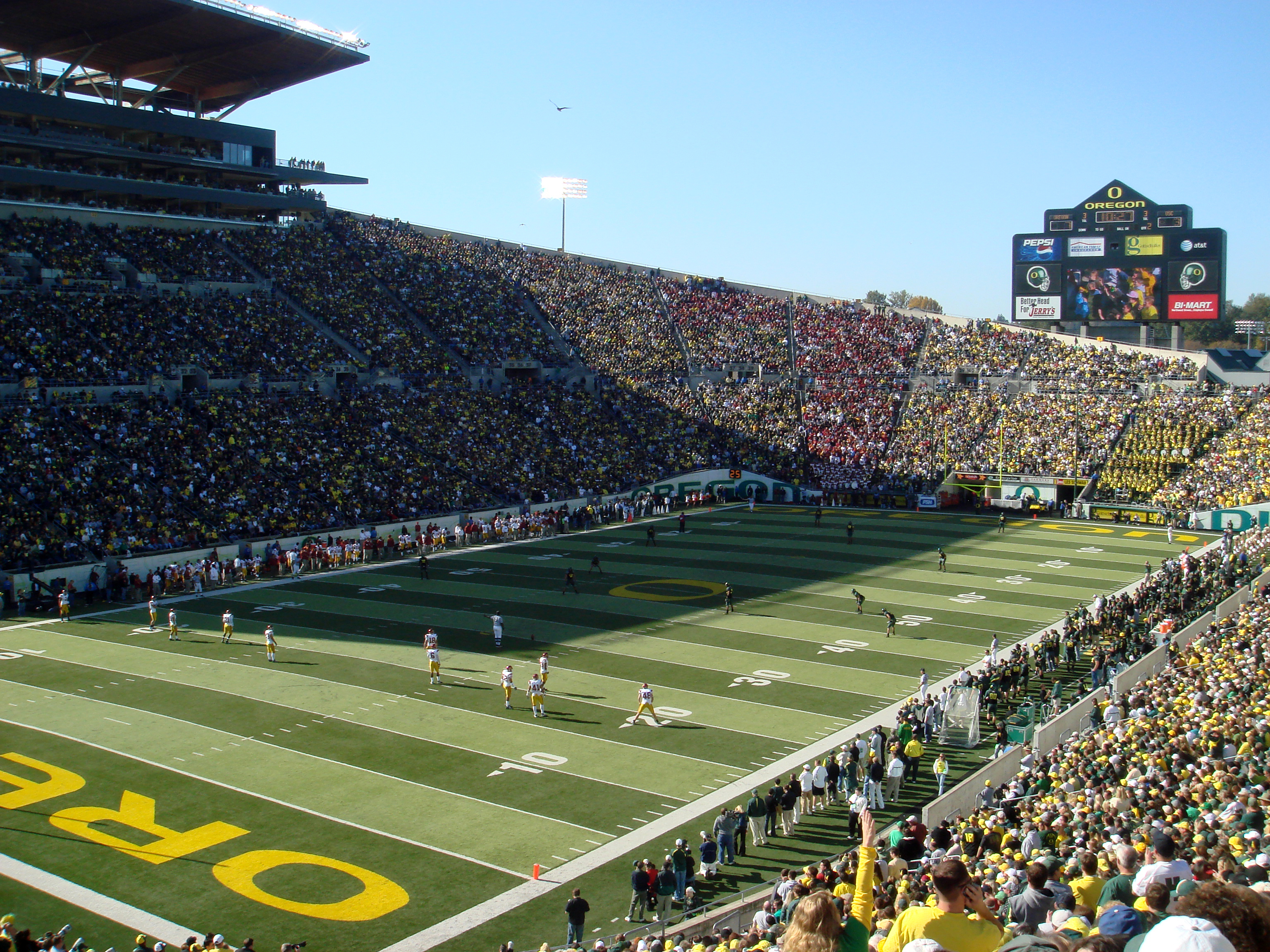
Oregon Ducks Stadium / Bobak Ha'Eri
The biggest difference between the two is that scholarship players are paid to play, whereas walk-on players pay to play.

"You have to consistently stand out on film," Oregon Ducks football player Ryan DePalo explained in a 2013 AddictedToQuack.com article. “They [the coaches] have nothing invested in you, whereas they have $100,000 invested in the scholarship player. If you don't consistently stand out, you will be forgotten.”

The differences between walk-on and scholarship players are undeniable. Walk-ons have fewer rights and fewer opportunity, especially in Division I. Walk-ons have to pay their way through college, only to be overlooked. With scholarship players rallying to unionize, walk-ons are once again being left out to dry.

Written by Asimina Hamakiotes and Gregory Sakas

Friday, April 18, 2014

Filling big shoes

Eli Manning / Marianne O'Leary - WikiCommons
Eli Manning is the franchise quarterback of the New York Giants. He has won two Super Bowls and was named finals mvp with the Giants. He has played with them since his 2004 rookie year..

Manning has faced a lot of pressure to fill the shoes of his elders, namely his father Archie Manning and older brother Peyton. While his dad never pressured any of his sons to play football, they all found their way to it one way or another.

In high school Manning attended the same school as his older brother Peyton, who was the star quarterback of the football team before Eli. There was a lot of talk if [Eli] Manning would be the same as his older brother, but he did not disappoint. He broke and set several records in the Isidore Newman High School’s history. His achievements earned him his own memorial at the school that is there to this day.

Manning has done quite a bit of charity work in his career. In 2007 Manning raised 2.5 million dollars to fund the construction of “The Eli Manning Children’s Clinics” at Blair E. Batson Hospital for Children. The clinic focuses on cancer treatment for children.

Manning had predicted his brothers success in his quote for his senior yearbook.

"Peyt - We had our fun times, and our serious times (watch out world, you ain't seen nothin' yet.)"

"That doesn't sound like Eli,” said Cooper Manning in response to the senior quote in a 2008 Daily news article. It was a change for the usually easy going Manning, but was true all the same. He went on to great success that he still sees today.

Friday, March 22, 2013

Tevez set to leave?

Carlos Tevez- Alfonso Jimenez / Flickr.com
Carlos Tevez is entering a critical point in his career. The 29-year-old Argentinian Manchester City Football Club striker is reaching the end of his contract in a year and has publically announced his desire to play for Boca Juniors. With the history of trouble he has amassed, this may become a reality.

During his time in England, Tevez has faced multiple charges affiliated with banned driving. Tevez was caught speeding while driving without a proper United Kingdom license and was suspended from driving for six months. On January 16, 2013, seven weeks after the start of his suspension, Tevez was found driving in the outskirts of Macclesfield. The huge pile of charges Tevez faces from all these events may lead to him being forced to take time away from the game.

His troubles with the police aren’t the only worries Tevez has faced in his career. In a Champions League game with MCFC against Bayern Munich on September 27, 2011, Tevez refused to play despite orders from his manager Roberto Mancini. "If I had my way he would be out of the club," said Mancini on Tevez after the incident in a Sportsmole article. Tevez’s conflicts with Mancini have brought him to the verge of retiring from soccer as he saw a major drop in playing time. Months after the incident, Tevez has changed. “I lack that hunger for goals; now I am thinking of supporting the move or providing the assist."

Despite his change in character, Tevez now has a desire to play for the Argentine club Boca. "I'm dying to wear the shirt of Boca again, but with the contract that I have here it's very difficult for me to leave.” What further complicates his departure, along with his contract, is the odd position that the MCFC team is in right now. The team sold their striker, Mario Balotelli, to AC Milan and is rumored to be parting with another striker Edin Dzeko next transfer window. If Mancini decides to sell Tevez, he will be left with Sergio Aguero as his only world-class striker.

With all of the trouble he faces in England, along with his expiring contract, Tevez must now reevaluate what he wants to do for the future of his career. Staying in England does not seem to be Tevez’s plan, but only time will tell if Mancini will be able to buy the striking force that will allow for Tevez to depart the club for Boca.


Contributed by Velid Mulić & Din Islam

Monday, June 4, 2012

Should college football be banned?

Santa Monica College VS. Cerritos College - flickr.com-Parker Michael Knight

College football is just a distraction that adds on to student's college life. It has no academic purpose and that's a reason why people want it to be banned. Student athletes are spending a lot of their time in college playing football instead of studying. Friday Night Lights author Buzz Bissinger argued for banning college footbal during the Intelligence Squared debate, he said, "As a school’s football team wins more games, grades drop and drinking rises among male students."

Another issue with college football is money. During the Intelligence Squared debate Bissinger said, "In the Division 1 Football Bowl Subdivision, schools spend an average of $13,471 per student. When you hone in specifically on athletes, that number jumps to $91,053. Coaches, for their part, receive an average salary of $1.47 million a year, far more than college presidents and 500 percent more than coaches earned in the mid ‘80s." A lot of college students are paying these extra fees that they are not going to use during the school year. A lot of the money is being spent on football instead of other equipment in school that everyone can use.

Football is dangerous for players. Over the course of one football season, a college football player will take about 1,000 hits to the head. Each hit damages the brain. This leads to chronic traumatic encephalopathy (CTE), a degenerative brain disease that causes memory loss, confusion, and depression. CTE can only be diagnosed when the person has a autopsy, so there is no way to find out if the person has CTE until the person dies. One example would be University of Pennsylvania's offensive lineman, Owen Thomas, a 21-year-old junior. He committed suicide by hanging himself in his apartment on April of 2010. After his death he was diagnosed with CTE.

Banning college football might not be a good idea, but what other solutions can there be? By banning college football, colleges and universities can save a lot of money. The money can go towards education instead of football. If students really want to play football they should join programs that pay them, instead of playing for free and at the same time worrying about school work.

Should college football be banned?

Football is one of the most popular sports in the United States; it’s played everywhere and by people of all ages. College football is a level below the biggest stage in football, the NFL. Although college football is widely accepted by fans and players, some people feel that football has an overall negative effect on players’ physical and academic progress.

Even though college football can help college students succeed in sports and have the opportunity to attend college because of scholarships, it does cause students to consider football over academics. Football exploits  players for their school's selfish purposes, but one of the main reasons for banning college football is the amount of head injury players receive during their football playing career and the negative impact there is on their future. Malcolm Gladwell, a Canadian author and journalist, spoke in a nytimes.com article about the pictures he’s seen of people’s brains and how it looked like they were run over by a truck. “I’ve seen pictures of the brain scans of people with C.T.E.,” he said, referring to the trauma-induced disease, “and it looks like someone drove a truck across their brain.” Gladwell is concerned about how football negatively affects a player’s brain in the long run to a point where the brain can no longer function properly because of the amount of hits they take. 

College football should be banned because players that don’t make it to the NFL end up finishing college with mediocre grades and have to give up their football dream. In the long run the former football players will develop conditions like Chronic Traumatic Encephalopathy (CTE) because of the hard hits received to the head. Overall playing football for four years in college isn’t worth the amount of pain you’ll receive in the future when the players start noticing the affects of their concussions.

Tuesday, May 15, 2012

Matt Barkley, possibly 2013 best NFL rookie?


Matt Barkley throwing a football
Neon Tommy/ Flickr.com


Matt Barkley is an outstanding quarterback at USC, and from.watching his improvements from previous years, it’s noticeable he’ll be an impressive NFL player. However, last year Barkley turned away the money  to stay in USC for his senior year. ESPN caught Barkley saying, “The 2012 team has some serious unfinished business to attend to, and I [Barkley] intend to play a part in it.”

This gives a ray of hope to USC, for with Barkley’s skill, it’s possible to accomplish two important things: another Heisman award and also a chance to win the national championship.

Each year Barkley has shown more and more improvement. During his freshman year, Barkley had a 59.9% passing percentage, 15 touchdowns, and 14 interceptions. The next year, he improved to a 62.6% passing percentage, 26 touchdowns, and 12 interceptions. Last season, Barkley, improved again with a 69.1% passing percentage, 39 touchdowns, and only seven interceptions. This coming season, it’s predictable the amount of touchdowns he throws will increase and the amount of interceptions will be even lower than in previous years.

Now being predicted to be the first pick of next year’s NFL draft, everyone has high expectations for him. Washington Coach Steve Sarkisian told Los Angeles Times, "If I'm an NFL head coach, right now, I'd pick Matt Barkley ahead of Andrew Luck. I think he's playing at that high of a level." Let's hope Barkley could live up to Coach Sarkisian's hope and all of the other of his supporters.

Monday, February 27, 2012

Who to blame, what to blame


Super Bowl XLVI poster from CHARMERS❀Chasing a Dream•*´¨`♥'s photos
During every Super Bowl there is always a turning point  However, the person getting blamed for causing the turning point is not always at fault. Super Bowl XLVI is the best example of this. It was an intense game with the final score 21-17 in favor of The New York Giants. The turning point was when Wes Welker, New England Patriots wide receiver got open in the fourth quarter, at New York’s 44 yard line, with four minutes left, and dropped a crucial pass.

All of the attention is now on Welker as he dropped the ball at the best opportunity to score. Welker took all blame saying, “When it comes to the biggest moment of my life and I don't come up with it, it's discouraging It seems like he had butter fingers,” at that moment. However, catching a ball that was thrown behind the himand on the other shoulder is a hard accomplishment to make. To catch a ball that complicated, Welker had to twist around in mid air and catch it. Welker already did the best he can holding it with both hands, but didn’t manage to stay with it going down. Bad throw? Yes it was. Who was the passer? Tom Brady.

This puts all of the pressure on Brady. Was he at fault for throwing terribly? No. He sprained his shoulder in the third quarter when New York Giants defensive end Justin Tuck tackled him. This was one argument for most people of why his passes were terrible. Injuring his shoulder allowed him to only complete seven of his 17 pass attempts. Before the tackle, Brady managed to complete 20 out of 24 passes. Brian Hoyer, Patriots backup quarterback describes Brady's fearlossness as, “I don’t know if I’ll ever meet someone as tough as he is.”

Welker and Brady were the two being blamed for the lost of the Patriots. However, Welker doesn't deserve full blame of not being able to capture a bad pass, and Brady doesn't deserve a full blame for throwing a bad pass with a sprain shoulder.

Related Posts Plugin for WordPress, Blogger...